
News1 October 2026
The Route You Planned Is Now the Route the Bus Drives
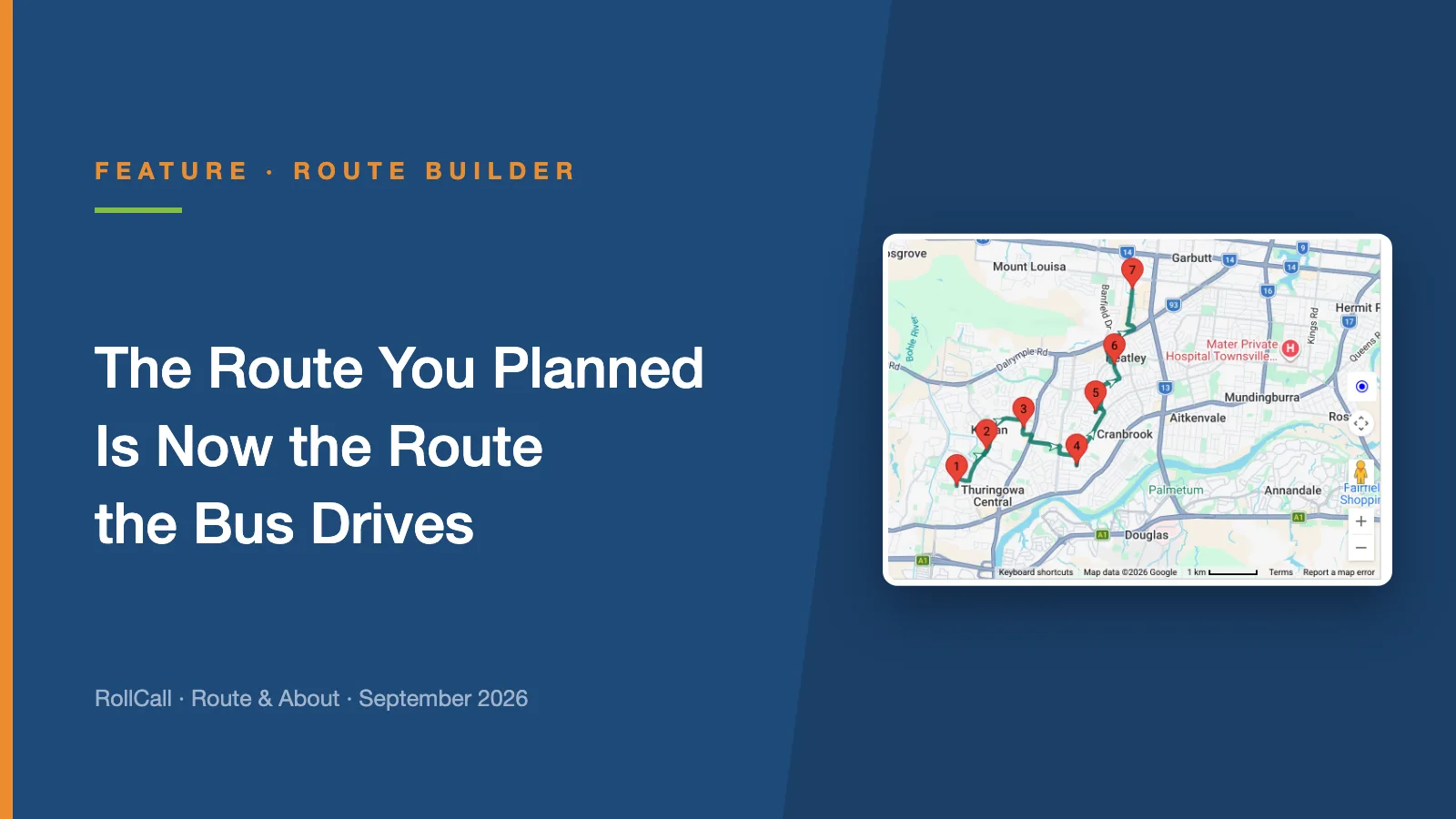
Until now, driver navigation found its own way between your stops. Plan Navigation lets you set the exact road, and the driver app follows it turn by turn.

Rollover has come a long way since you last tried it. Here is why this is the year to look again.
Let us start with the part we do not usually put in a newsletter.
Three or four years ago, rollover was new. A handful of schools tried it, and for some of them it did not go well. It was early, it asked too much of people, and it did not handle the messy realities of a real school transport service as gracefully as it should have.
If you were one of those schools, that experience stuck. Entirely reasonably. Nobody who has had a bad rollover in December goes looking for a second one.
And so every year since, a group of our longest-standing customers has quietly set next year up by hand instead - because the memory of that first attempt is still doing its job.
We would like to change that this year.
If rollover burnt you once, we understand why you haven't been back. We'd genuinely like you to look again.
Rollover has not been thrown out and started again. It has been enhanced, steadily, over the past couple of years - a great deal of work, most of it in direct response to what went wrong for those early schools.
The single most important change is that it now walks you through the process.
Rather than presenting you with a screen and hoping you know what to do next, rollover takes you step by step through the whole thing - confirm your term dates, tell it your final year level, bring in your new students, create next year's routes and calendars, review each route, and go. Every stage is something you can look at, adjust, leave and come back to. Nothing commits until you say so.
Beyond that, three changes matter more than the rest.
Previously you had to nominate a single representative day, and whatever happened on that day became next year. That worked well enough for five-day travellers and poorly for everyone else.
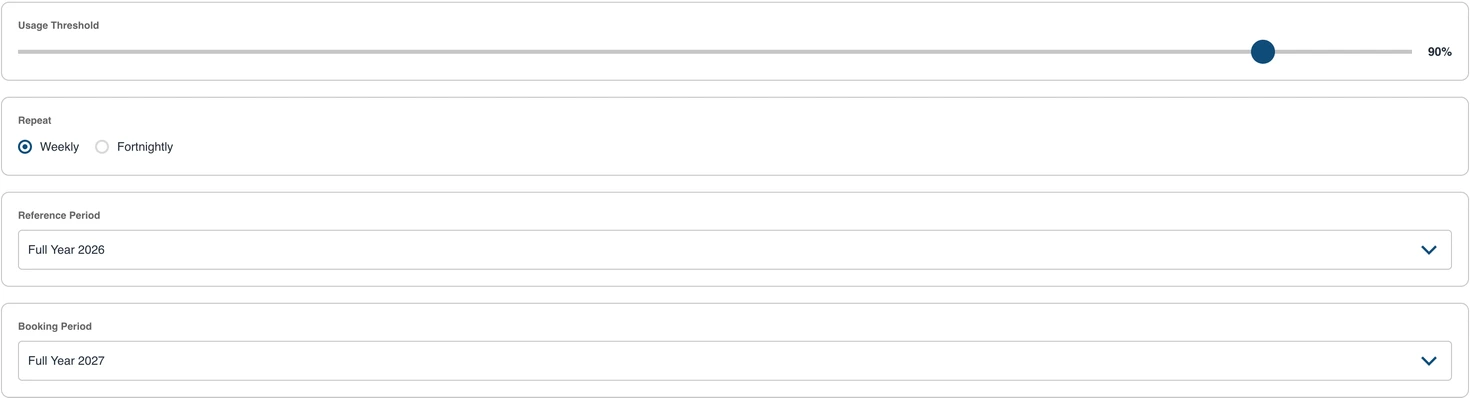
Now you choose a representative term instead - Term 3 of this year, for instance - and set a threshold for how frequently a student needs to have travelled to be carried over. A family who catches the bus Monday, Wednesday and Friday rolls over as exactly that, because rollover is reading a term of real travel rather than one sampled morning.
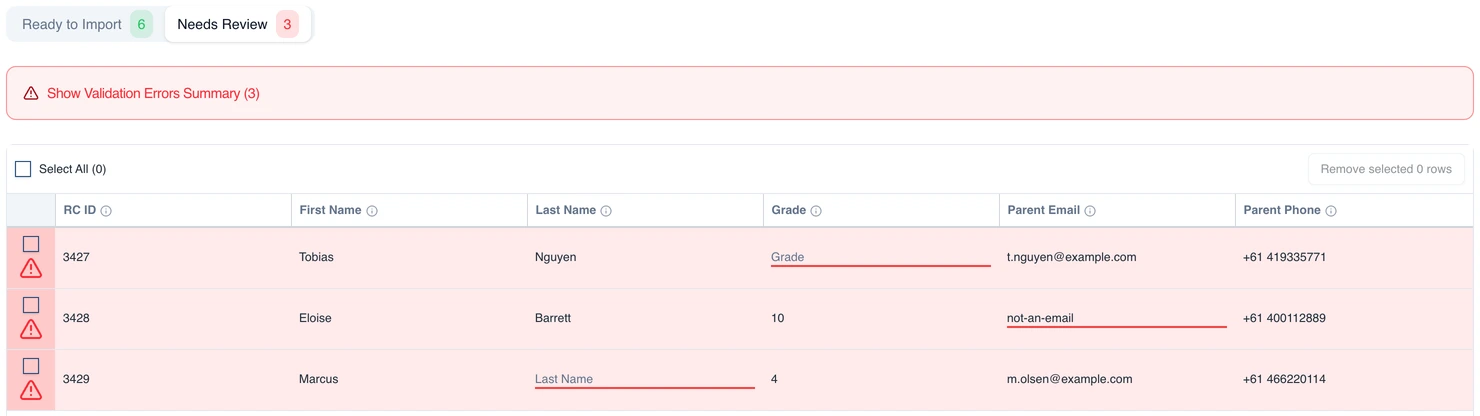
If you prepare your students by CSV, the import has been considerably improved.
It now checks your file before anything is written and brings any problems up on screen, where you can edit them directly - a sandbox, effectively. Fix the rows that need fixing and carry on. Or if the file is in worse shape than you thought, bail out entirely, go and sort the data properly, and come back and try again.
The difference is when you find out. Previously you imported and then worked out what had gone wrong. Now you see it first, while nothing has happened yet.
This is the one we most want the schools who were burnt to hear.
If you run your rollover and it is not right - something was set up wrong, a decision was wrong, you have simply made a mess of it - you can roll it back.
It is worth sitting with what that changes. The reason a bad rollover was so painful was never really the mistake. It was being stuck with it: next year half-built, this year disturbed, and no clean way back to where you started. That is what people remember, and it is entirely why they never tried again.
The worst case is now that you reverse it and have another go.
You are no longer betting your December on getting it right first time.
There is more to it than these three, and we will go through all of it properly over the coming months. For now the point is simply this: the thing you tried a few years ago and the thing available to you in Term 4 are not the same product.
This is the misunderstanding we hear most often, and it stops more schools than anything else - so it is worth being very clear about.
Rolling over RollCall and setting up next year in your student management system are two separate jobs.
If your school runs an integration - TASS, Compass, Sentral or another - that system has its own rollover, on its own timeline, usually managed by someone else entirely. It is easy to assume that your RollCall rollover has to wait until that is finished.
It does not.
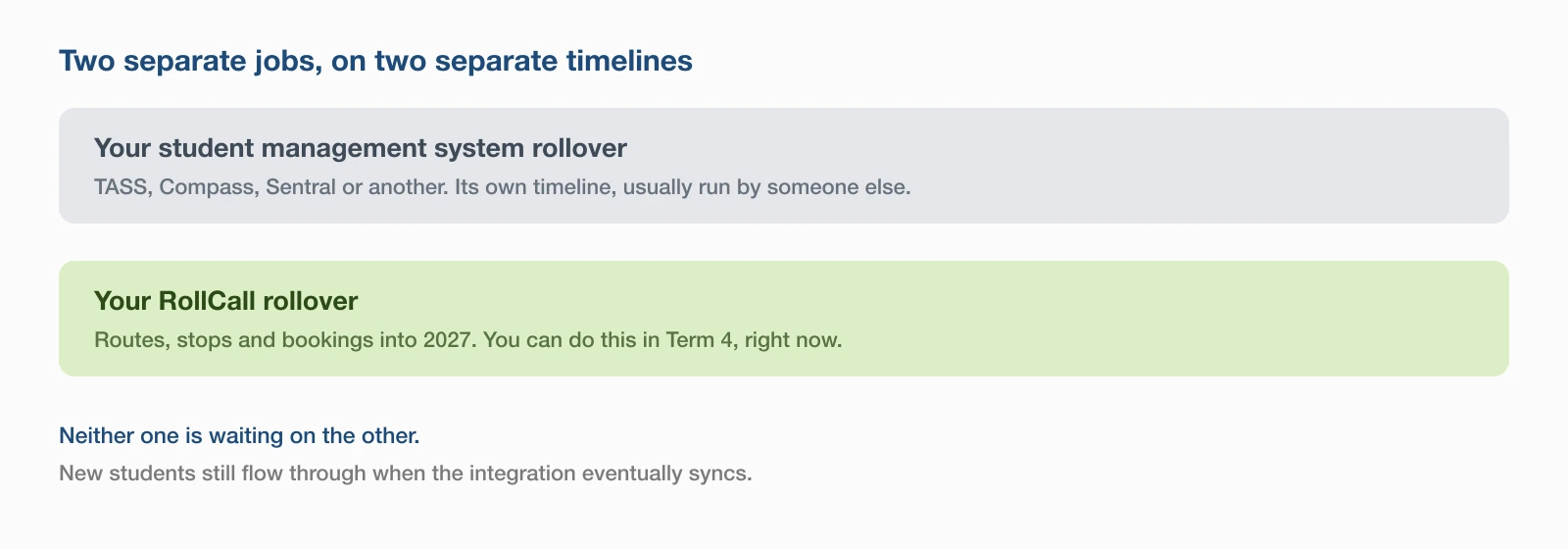
The two run in silo. You can roll your RollCall routes, stops and bookings over into 2027 well before your integration rolls over, and nothing about doing so interferes with the sync when it eventually happens. Your new students will still flow through when they flow through.
Which means the answer to "we cannot start yet, we are waiting on the integration" is, in almost every case, that you can start now.
The rollover dashboard opens with hardware and consumables, and there is a reason it comes first.
If your school uses custom tags, order them at the start of Term 4.
They have to be produced and delivered, and that takes the time it takes. Ordering in December - or worse, in that first week back - is how schools end up starting the year with students travelling untagged.
If you use student NFC cards rather than custom tags, none of this applies to you and you can skip straight past it. And if you have been thinking about changing or upgrading your devices, or adding new ones, that can be handled as part of the rollover too.
Everything else in this article can wait a few weeks. This one cannot.
Here is the argument that matters most, and it has nothing to do with software.
Think about what the week before students return actually looks like.
You have a couple of days. Maybe a week. In that time there are new staff to induct, timetables to confirm, enrolments still arriving, rooms to sort out, and a phone that starts ringing the moment families realise term is close. Everyone in the school wants something from the office, and they all want it before Monday.
Now add to that: setting up an entire year of school transport from nothing.
Routes. Stops. Calendars. Every student allocated. Every booking created. All of it done in the week you have least time and most interruptions, by someone who has just come back from leave and is trying to remember how it works.
That is not a software problem. That is a workload problem, and it is one we can take off your plate entirely.
Do it in Term 4, and January becomes a week about people rather than a week about data entry.
Roll over before you go on leave and you come back to a transport service that already exists. Next year's routes are there. Your students are on them. Your calendars are built.
What is left in January is the genuinely new work - the families who enrolled over summer, the changes that came in late, the handful of things that always need a human. That is an afternoon, not a fortnight.
There is a second advantage too. Doing it in Term 4 means doing it while the people who know your service are still at work, while your bus operator is still answering the phone, and while our support team is fully staffed and not fielding the entire sector at once in the last week of January.
If something needs sorting out, it gets sorted out calmly, in October, by people who are not also trying to get a school open.
We are making rollover our focus between now and the end of the year, and this article is the opening of that.
Over the coming months you can expect:
We are doing it this way deliberately. A single announcement was never going to shift an experience somebody had four years ago. What shifts it is showing you the process properly, more than once, and being available while you do it.
If you have not rolled over since that first attempt - or if you have never tried it at all - this is the year we would like to walk you through it.
Nothing complicated.
Rollover has never been the interesting part of your year. But it can stop being the part that ruins your first week back.
Register your interest and we will make sure you hear about the training sessions and webinars as they are scheduled. Email support@rollcall.com.au.
Until now, driver navigation found its own way between your stops. Plan Navigation lets you set the exact road, and the driver app follows it turn by turn.
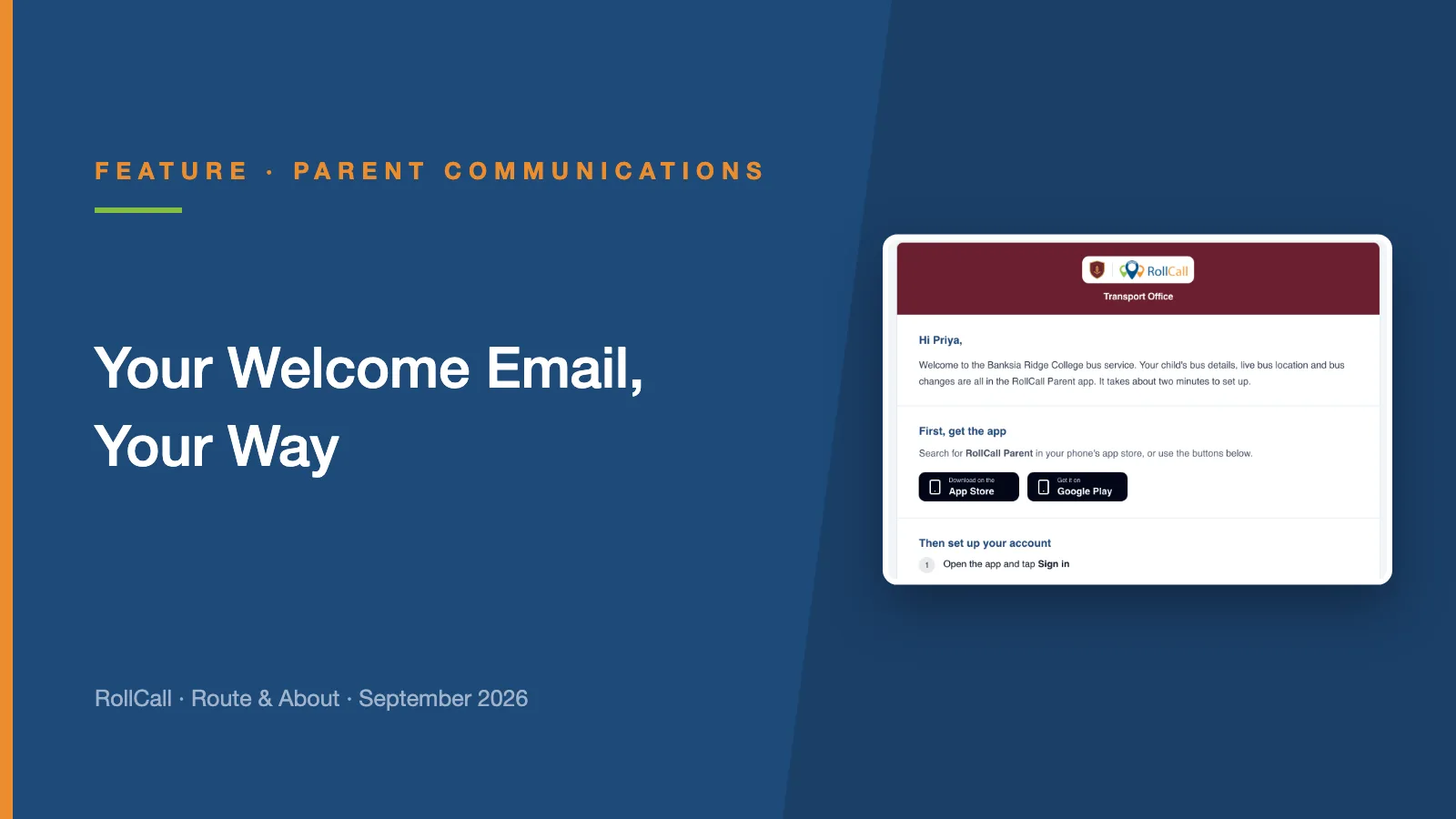
The welcome email is the first thing a new family gets from RollCall. Now your school runs it: your logo and colours, your wording, and a preview of exactly what families receive.

In the same week in September, Amanda visited our schools in Townsville and Cairns, and Dean took the RollCall stand to the SAHISA 2026 Conference in Durban.